
Home -- Villa Rental -- Map
Nature: - Bulbs and Orchids
- Trees and Bushes - Other Flowers
Butterflies and Moths - The Dragonfly
- Creepy Crawlies
- Birds
Snakes in the Algarve
I have had several inquiries from people who have encountered snakes in the Algarve. The cat or dog has brought one into the house, or one has been discovered in a shed or the garden and they are worried as to the danger.
Generally, although there are some venomous snakes here in the Algarve, they are not dangerous to humans, because either their poison fangs are at the back of the mouth or they cannot open their mouths wide enough for them to be effective against anything much larger than a lizard, frog or mouse. The venom is also not considered particularly virulent and one would have to be extremely stupid in trying to handle the snake to get bitten at all.
Most snakes run for cover at the sound or vibration of something large approaching.
Snakes are quite variable in colouring, and some young ones, as these may have been, are more strongly patterned.
According to my book there are 8
species of snake in the Algarve.
1. Montpellier Snake: malpolon monspessulanus
Grows to nearly 2m. Pattern
variable. Heavy brow ridges. Juveniles may have irregular light markings, but
can have more regular pattern around head. Fangs at back of mouth. Venom after
prolonged bite due to handling! produces numbing, stiffness and swelling for a
few hours.
2. Horseshoe Whip Snake:
coluber hippocrepus Grows to 1.5m. Fairly
slender. Bold pattern of dark edged blotches. Can be found near human habitat
and buildings. No fangs.
3. Ladder Snake: elaphe scalaris Grows to 1.60m. Juveniles have
distinctive ladder pattern, of which the "rungs" fade to become
lateral lines when adult. A constrictor. No fangs.
4. Grass Snake: natrix natrix Grows to usually 1.2m, but can
reach 2m. A snake of damp places. Hisses and strikes with mouth closed. No
fangs.
5. Viperine Snake: natrix maura 70cm to 1m. Two rows of
staggered dark blotches mid-back. Flanks may have large light centred eye-like
spots. Often found in or near water, swims well. Strikes with mouth closed.
Behaviour and colouring give viper-like impression. No fangs.
6. Southern Smooth Snake: coronella girondica
50cm to 80cm. Grayish/
brownish/ pinkish with dark bars. Not active by day. Rarely bites. No fangs.
7. False Smooth Snake: macroprotodon cucullatus
Up to 65cm, but usually
around 45cm. Pallid grey or brown with small dark markings forming bars or
streaks. Active at dusk and night. In ruins and old walls during the day - under
stones etc. Slow, except when handled. Bites, but fangs at back of mouth and
small size prevents effective use on humans.
8. Lataste's Viper: vipera latasti Under 60 cm. Has distinct nose
horn. Relatively stout with triangular head. Wavy or zig-zag dorsal stripe with
darker edge. Quite irascible, but bite not considered serious. (The adder, or
common viper found in the UK and northern Spain is more dangerous than this one
of the South).
Snakes are more frightened of you! and we find that usually one only glimpses a
vague unidentifiable shape as it glides off into cover, scared by the noise of
your approach.
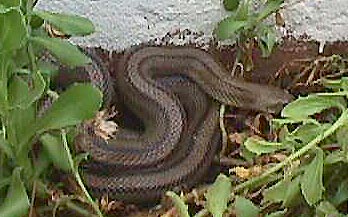
I do not know how common or rare most of the above snakes are. Grass snakes are
quite often on the tracks around here, but rarely near the house. The Ladder
snake below I photographed close to our large cistern. Most people seem to send
me photographs of the Horseshoe Whip snake, as it is commonly to be found in
walls and outbuildings.
 |
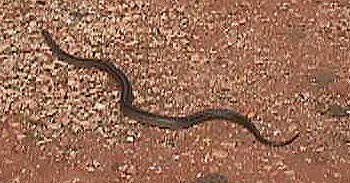 |
| Snissa hiding in the garden on 27th May 1999 | Snissa running away as it's camera-shy |
According to our snake book, this is an adult ladder snake.
Dangerous Beasties
It is advisable to wear gloves when
undertaking rock clearing etc..
The largest European centipede "scolopendra cingulatus" has a painful
and potentially dangerous bite. These sometimes invade the house, when the
conditions are damp, and are very hard to kill!
Scorpions can give one a very painful and persistent (up to a week or more)
sting, often attacking when their sheltering stone is turned over.
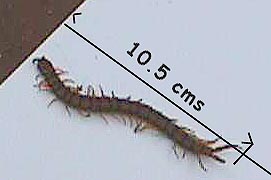 |
| Centipede "scolopendra cingulatus" |
Although not experts, we always try and identify the flowers, birds, reptiles, insects and mammals that we see around, using a small collection of reference books.
Nature: - Bulbs and Orchids
- Trees
and Bushes - Other Flowers
Butterflies and Moths - Birds - Amphibians and Reptiles
Send mail to info@valegrifo.com
with questions or comments about this web site.
Copyright © 1999 Vale Grifo
Last modified: November 11, 2009